MySaxdor AI Assistant
Cadentia × Saxdor
An AI assistant for Saxdor owners spanning the whole ownership journey, from discovery and buying to owning and maintaining the boat.
Details
- Year
- 2025–2026
- Role
- Designer
- Services
- Concept Design, Conversation Design, UX/UI Design
- Website
- cadentia.ai
Overview
An AI assistant for Saxdor owners spanning the whole ownership journey: from discovery and buying to owning and maintaining the boat. Saxdor won the 2026 Grand One Winner Award for Best Digital Service together with Cadentia and Younite.
The Problem
Saxdor customers need support at different moments of the customer journey, whether before purchase, while buying, during onboarding, in day-to-day ownership and operation, or when planning where to go. The early concept put a chat interface first as the way to guide users through all of it. The question became whether that bet on chat was right.
Approach
A broad scope at a fast-paced startup, so I optimised for learning fast over formal studies. Insights came from stakeholders, the customer essentials Saxdor had already identified, past insights, informal interviews with boat users, and extensive research of similar products. Consistent team reviews meant we adapted as we learned.
Key Decisions
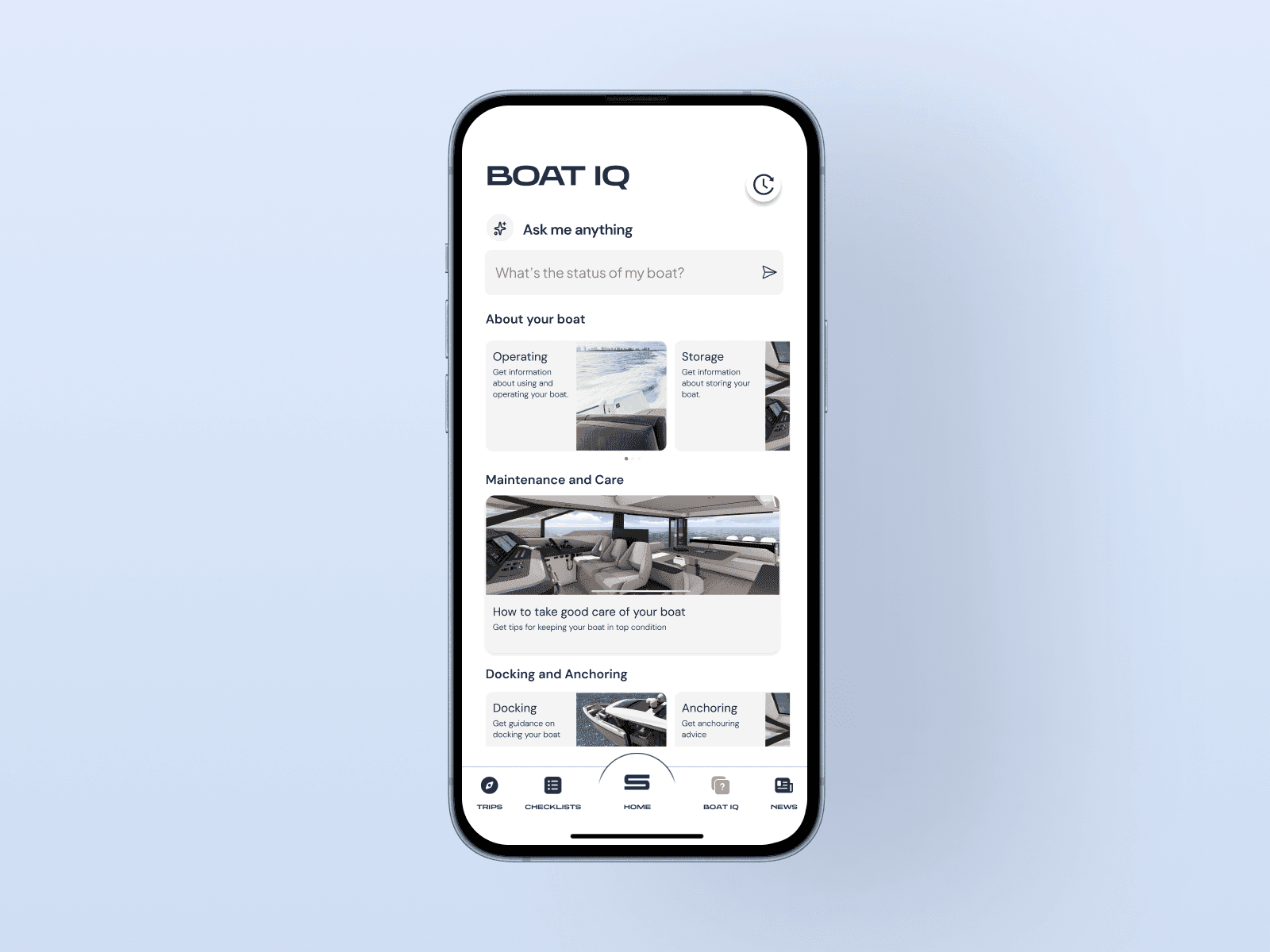
From chat-first to a contextual interface
Discoverability with a conversation-first design was low, and forcing users into a chat layer without a strong reason didn't engage them. We moved from in-chat widgets toward a contextual interface where the AI knows what the user is viewing and adapts the conversation to it.
From scene-by-scene to intent-adaptive conversation
For the AI companion, I defined the AI's profile, task, tone, and response structure. The key change I made was replacing a scene-by-scene flow with an adaptable conversation that follows the user's intentions. I also ensured longer responses follow a structured format, so they read more easily.
A shared cross-vertical concept
I also developed a concept for trip planning, which remains in development. The concept roadmap was created in cooperation with the events-vertical designer, building on a parallel planning feature and a map feature I had designed in the events vertical (see Event Companion).
Designing the dealer-side monitoring
I redesigned the Activity page where dealers and employees track customer conversations with the AI, adding message flagging and a flagged-messages queue where issues are resolved easily, built to hold up with many people using the monitoring pages.
Outcome
The Smart Manual and Service Assistant are shipped and live in the MySaxdor app. The product won Grand One 2026, Best Digital Service (Saxdor Yachts with Cadentia and Younite).
Reflection
This project taught me about working with multiple stakeholders, the weight of effective communication, and really thinking through when AI is needed and how. A chat is often the wrong default for an AI product. The judgment is knowing when an interface serves the user better.