Dinner Food App
Aalto University
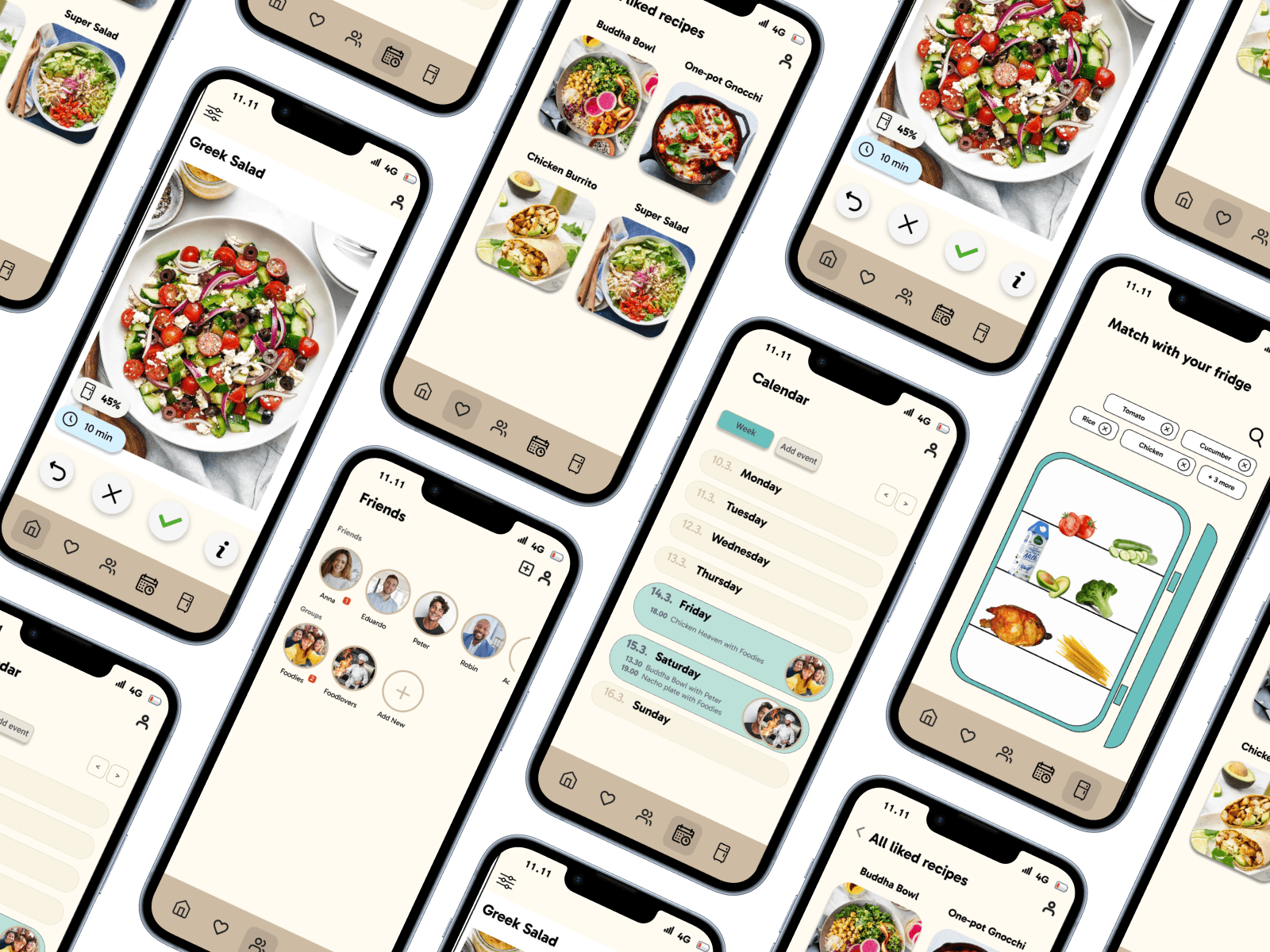
Dinner turns "what should we eat?" from a daily chore into a quick, playful discovery. A recipe app for finding, saving, and planning meals, designed and tested through two research-and-iterate cycles.
Details
- Timeline
- 01/2025 – 04/2025
- Role
- UX/UI Lead (prototyping & design direction)
- Services
- Concept, UX/UI Design, User Research
- Prototype
- View full prototype in Figma
The Problem
Deciding what to eat is a small daily friction that adds up. For people sharing a kitchen it is harder, since two sets of cravings have to meet somewhere. The usual fix, scrolling recipe sites and feeds, takes a lot of active searching and often ends in the same few meals and a fridge of forgotten ingredients.
We started from "food takes time," mapped the problem space, and narrowed to three sub-problems, namely knowing what you already have, finding recipes for those ingredients, and understanding the nutrition in your food. We chose these based on relevance to our target group (students and young adults), the societal impact of cutting food waste, and the time pressure our users live with.
Approach
I worked on the UX/UI and was one of the people responsible for the interactive prototype in Figma, so we could test the idea rather than just describe it. Throughout, we grounded our decisions in user research, challenged our own assumptions, and kept the team open to honest critique.
The concept borrowed a familiar gesture from Tinder. Swipe right to save a recipe, left to skip. A fridge tool let users enter ingredients they already had so the app could surface recipes using as many as possible, and a matching tool let people sharing a kitchen link profiles and see the recipes they both liked.
The turning point came in testing. We put the prototype in front of target-group users across two cycles, and the hardest, most useful result was that only about 30% thought the app would actually save time. The promise we had built the product around did not hold. What did land was inspiration and using up what people already had. As a team, we worked through what each new direction would mean for different users, including those with specific dietary needs, and reframed our value proposition toward food inspiration and reducing food waste. The fridge tool, which we had treated as a nice extra, turned out to be one of the strongest reasons people saw to cut waste, so it moved closer to the centre of the product.
Key Decisions
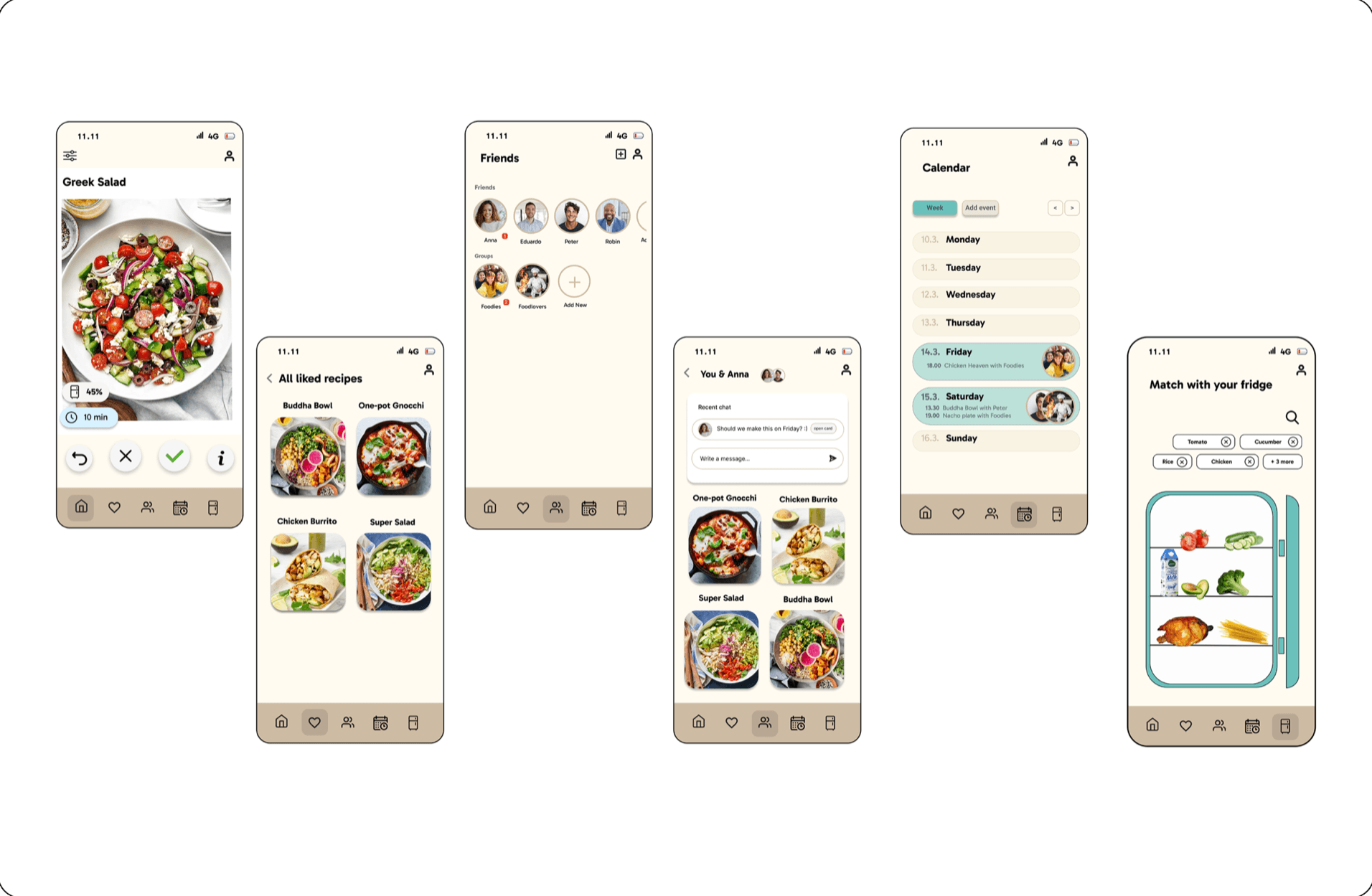
The recipe match % read as dating
We replaced it with an "also liked by" stamp, keeping the social value without the dating misread.
Entering a whole fridge felt like work
We switched to quick-add for a few specific ingredients, since people more often ask "what do I make with this?" than inventory a fridge.
Calendar times felt too exact
We moved to broad meal slots (breakfast, lunch, snack, dinner, supper) to match how people actually plan.
Users valued different features
We kept features modular, so no single feature is required for the app to work.
Sharing a recipe was clunky
We added direct share from the swipe view, instead of liking a recipe and then digging through saved ones.
Outcome
The outcome was a validated direction for the product. Two test cycles turned our initial time-saving assumption into an evidence-backed proposition, a recipe-discovery experience built around inspiration and using what you have, with social features and fridge-matching layered on top. We ended with a clearer problem, a product shaped to fit it, and a documented backlog of what to build next. During the final demo we received a lot of enthusiasm and positive feedback for our prototype.
Reflection
This project showed me the full product development process and the value of testing with the right people. I learned to weigh user research and feedback through a systems lens, asking what implementing a feature would do across different user groups and contexts, and to facilitate discussions so the team stayed focused on the core goal while still making grounded decisions.